 |
|
|
last
update
(19/10/2023)
PHOTONIC LABORATORY
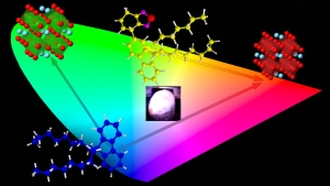
The Photonic Laboratory of the Dipartimento di Matematica e Fisica "Ennio De Giorgi" was born in 2006 in order to investigate the optical properties of a wide range of organic and inorganic materials. The main research activity of the Photonic Laboratory is the investigation of the photophysics of organic conjugated molecules and of lead halide perovskites, with particular interest for the processes relevant for the operation of optical and optoelectronic organic devices. The current research lines are:
All our papers are available in the Publication section. Please feel free to contact us for further details and possible collaborations.
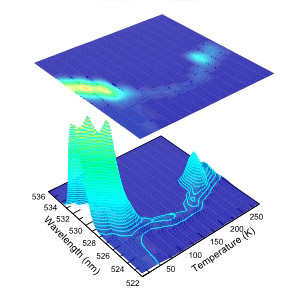
Photophysics of perovskites thin films Thin films of leas halide perovskites are receiving huge attention in the last few years, thanks to their capability to combine optical, electronic and optoelectronic properties typical of inorganic semiconductors with easy processing, typical of organic materials. Our activity is mainly focused on the investigation of the physical processes that determine the optical properties of perovskites thin films, with particular interest for the optical gain properties of the material.
Recent publications -S. Milanese, G. Morello, M. L. De Giorgi, A. Cretì, H. Andrusiv, M. I Bodnarchuk, A. Qualtieri, M.Lomascolo, M. V. Kovalenko, and M. Anni"Air-sensitive amplified spontaneous emission in lecithin-capped CsPbBr3 nanocrystals thin films" Materials Today Physics 35, 101098 (2023). Open access -A. Cretí, M. Lomascolo, Y. Zhang, M. L. De Giorgi, O. F. Mohammed, and M. Anni "Aging Effects on the Exciton Relaxation and Diffusion Processes in CsPbBr3 Nanocrystals" Advanced Optical Materials 11, 2202062 (2023). Open access - G. Morello, S. Milanese, M. L. De Giorgi, N. Calisi, S. Caporali, F. Biccari, N. Falsini, A. Vinattieri, and M. Anni "Temperature-Dependent Amplified Spontaneous Emission in CsPbBr3 Thin Films Deposited by Single-Step RF-Magnetron Sputtering" Nanomaterials 13, 306 (2023) Open access -S. Milanese, M. L. De Giorgi, L. Cerdán, M. G. La-Placa, N. F. Jamaludin, A. Bruno, H. J. Bolink, M. V. Kovalenko and M. Anni "Amplified Spontaneous Emission Threshold Dependence on Determination Method in Dye-Doped Polymer and Lead Halide Perovskite Waveguides" Molecules 27, 4261 (2022) Open access- C. Triolo, M. L. De Giorgi, A. Lorusso, A. Cretì, S. Santangelo, M. Lomascolo, M. Anni, M. Mazzeo, and S. Patané, "Light Emission Properties of Thermally Evaporated CH3NH3PbBr3 Perovskite from Nano- to Macro-Scale: Role of Free and Localized Excitons", Nanomaterials 12, 211 (2022). Open access - M. L. De Giorgi, and M. Anni "Amplified Spontaneous Emission in low dimensional lead halide perovskites: An overview", Optical Materials: X, 12, 100115 (2021) Open access -A. Balena, A. Cretì, M. Lomascolo and M. Anni "Investigation of the exciton relaxation processes in poly(9,9-dioctylfluorene-co-benzothiadiazole):CsPbI1.5Br1.5 nanocrystal hybrid polymer–perovskite nanocrystal blend" RSC Advances 11, 33531 (2021) Open access -M. Anni, A. Cretí, M. L. De Giorgi, and M. Lomascolo “Local Morphology Effects on the Photoluminescence Properties of Thin CsPbBr3 Nanocrystal Films” Nanomaterials 11, 1470 (2021). Open access - M. L. De Giorgi, A. Cretì, M.-G. La-Placa, P. P. Boix, H. J. Bolink, M. Lomascolo and M. Anni “Amplified spontaneous emission in thin films of quasi-2D BA3MA3Pb5Br16 lead halide perovskites” Nanoscale 13, 8893-8900 (2021). - M. L. De Giorgi, S. Milanese, A. Klini, and M. Anni, M. “Environment-Induced Reversible Modulation of Optical and Electronic Properties of Lead Halide Perovskites and Possible Applications to Sensor Development: A Review” Molecules 26, 705 (2021) Open access -M. L. De Giorgi, T. Lippolis, N. F. Jamaludin, C. Soci, A. Bruno, and M. Anni “Origin of Amplified Spontaneous Emission Degradation in MAPbBr3 Thin Films under Nanosecond-UV Laser Irradiation” Journal of Physical Chemistry C, 124, 10696–10704 (2020). Open access -M. Anni, A. Cretì, Y. Zhang, M. L. De Giorgi, and Mauro Lomascolo “Investigation of the role of the environment on the photoluminescence and the exciton relaxation of CsPbBr3 nanocrystals thin films” Applied Sciences 10, 2148 (2020). Open access - M. L. De Giorgi, F. Krieg, M. V. Kovalenko and M. Anni “Amplified Spontaneous Emission Threshold Reduction and Operational Stability Improvement in CsPbBr3 Nanocrystal Films by Hydrophobic Functionalization of the Substrate” Scientific Reports 9, 17964 (2019). Open access - M. L. De Giorgi and M. Anni “Amplified Spontaneous Emission and Lasing in Lead Halide Perovskites: State of the Art and Perspectives” Applied Sciences 9, 4591 (2019). Open access -A. Perulli, A. Balena, M. Fernandez, G. Nedelcu, M. V. Kovalenko, M. Lomascolo, and M. Anni "Full color tuning in binary polymer:perovskite nanocrystals organic-inorganic hybrid blends" Applied Physics Letters 112, 171904 (2018). Selected as Featured Article and reviewed on AIP Scilight 2018, 170005 (2018); -A. Balena, A. Perulli, M. Fernandez, M. L. De Giorgi, G. Nedelcu, M. V. Kovalenko, and M. Anni "Temperature Dependence of the Amplified Spontaneous Emission from CsPbBr3 Nanocrystal Thin Films" Journal of Physical Chemistry C 122, 5813 (2018). - M. L. De Giorgi, A. Perulli, Andrea, N. Yantara, P. Boix and M. Anni “Amplified Spontaneous Emission Properties of Solution Processed CsPbBr3 Perovskite Thin Films" Journal of Physical Chemistry C 121, 14772 (2017).
Stimulated Emission in organic thin films
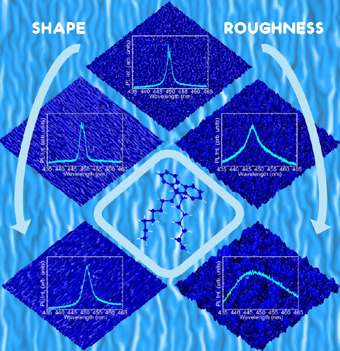
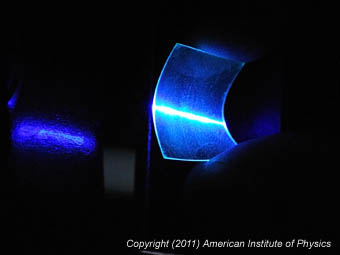
Several organic materials show optical gain, and can be thus used as active materials for LASER devices. Our research activity is focused on the investigation of the physical processes determining the material optical gain, whose knowledge and control is fundamental for the gain maximization, and the light amplification and lasing threshold minimization. The activity includes: - Investigation of the presence of Amplified Spontaneous Emission in new organic systems. - Investigation of the processes affecting the ASE threshold. - Realization and characterization of organic random lasers.
Main publications -M. Anni "Investigation of
the Origin of High Photoluminescence Quantum Yield in
Thienyl-S,S-dioxide AIEgens Oligomers by Temperature
Dependent Optical Spectroscopy" Molecules 28, 5161
(2023). Open access
-L. Cerdán, M. Anni, M. L. De Giorgi, P. G. Boj, and M. A. Díaz-García "Unveiling photophysical and photonic phenomena by means of optical gain measurements in waveguides and solutions" Optics & Laser Technology 136, 106766 (2021) -S. Milanese, M. L. De Giorgi and M. Anni “Determination of the Best Empiric Method to Quantify the Amplified Spontaneous Emission Threshold in Polymeric Active Waveguides” Molecules 25, 2992 (2020). -T. Virgili, M. Anni, M. L. De Giorgi, R. Borrego Varillas, B. M Squeo, and M. Pasini “Deep Blue Light Amplification from a Novel Triphenylamine Functionalized Fluorene Thin Film” Molecules 25, 79 (2020). - M. Anni “Dual band amplified spontaneous emission in the blue in Poly(9,9-dioctylfluorene) thinfilms with phase separated glassy and β-phases” Optical Materials 96, 109313 (2019) - M. Anni “Poly[2-methoxy-5-(2-ethylhexyloxy)-1,4-phenylenevinylene] (MeH-PPV) Amplified Spontaneous Emission Optimization in Poly(9,9-dioctylfluorene (PFO):MeH-PPV Active Blends” Journal of Luminescence 215, 116680 (2019) -M. Anni, D. Rhee, and W.-K. Lee “Random Lasing Engineering in Poly-(9-9dioctylfluorene) Active Waveguides Deposited on Wrinkles Corrugated Surfaces” ACS Applied Materials and Inferfaces 11, 9385-9393 (2019). - M. Anni "The Physics behind Amplified Spontaneous Emission in Organic Active Waveguides" published in "Organic Lasers: Fundamentals, Developments, and Applications" edited by M. Anni and S. Lattante, Pan Stanford. -S. Lattante "Basic concepts of stimulated emission and lasing in organic materials and Optical Gain experimental determination" published in "Organic Lasers: Fundamentals, Developments, and Applications" edited by M. Anni and S. Lattante, Pan Stanford. -S. Lattante, M. L. De Giorgi, M. Pasini and M. Anni “Low threshold Amplified Spontaneous Emission properties in deep blue of poly[(9,9-dioctylfluorene-2,7-dyil)-alt-p-phenylene] thin films" Optical Materials 72, 765 (2017). -S. Lattante, A. Cretì, M. Lomascolo and M. Anni “On the correlation between morphology and Amplified Spontaneous Emission properties of a polymer:polymer blend” Organic Electronics 29, 44-49 (2016). -M. Anni, S. Lattante “Amplified Spontaneous Emission optimization in region regular-poly(3-hexylthiophene) (rrP3HT):poly(9,9-dioctylfluorene-co-benzothiadiazole) (F8BT) thin films through control of the morphology” Journal of Physical Chemistry C 119, 21620–21625 (2015). -M. Anni “Operational lifetime improvement of poly(9,9-dioctylfluorene) active waveguides by thermal lamination” Applied Physics Letters 101, 013303 (2012). -M. Anni, A. Perulli, G. Monti “Thickness dependence of the Amplified Spontaneous Emission threshold and operational stability in poly(9,9-dioctylfluorene) active waveguides” Journal of Applied Physics 111, 093109 (2012) . -M. Anni “Photo-Degradation Effects on the Emission Properties of Amplifying Poly(9,9-dioctylfluorene) Active Waveguide Operating in Air” Journal of Physical Chemistry B 116, 4655-4660 (2012) -M. Anni "A flexible organic random laser based on poly(9,9-dioctylfluorene) deposited on a surface corrugated poly-phthalate-carbonate substrate" Applied Physics Letters 98, 253304 (2011). -M. Anni, M. Alemanno "Temperature dependence of the Amplified Spontaneous Emission of the of Poly(9,9-dioctylfluorene) β-phase” Physical Review B 78, 233102 (2008) -M. Anni, M. Alemanno “Spectral effects of gain saturation in the β-phase of Poly(9,9-dioctylfluorene)” Applied Physics Letters 93, 123311 (2008) -M. Anni "The role of the β-phase content on the Stimulated Emission of Poly(9,9-dioctylfluorene) thin films" Applied Physics Letters 93, 023308 (2008). |